Architectural Context & Enterprise Requirements
Prevent internal VPC scanning and cloud credential theft by rejecting RFC1918/link-local targets after DNS resolution and enforcing IMDSv2. For industrial holdings, fast-growing SaaS platforms, and high-traffic enterprise portals, modern Server Ops & Cybersecurity directly drives uptime, unit economics, and search discoverability.
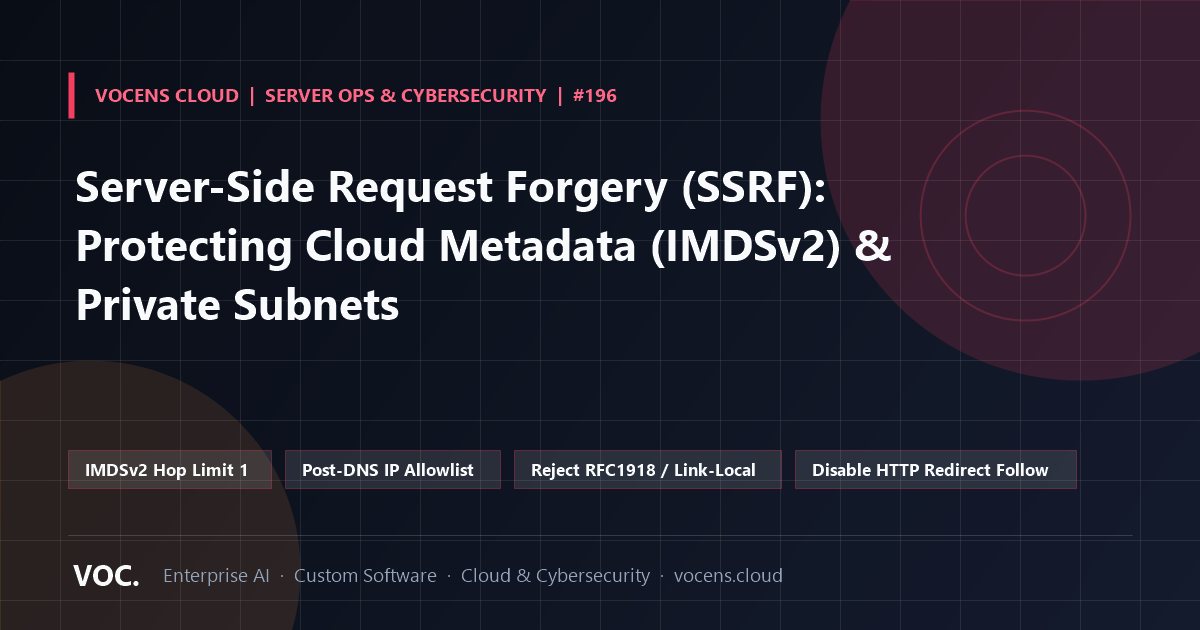
Drawing on engineering experience since 2013, Vocens Cloud combines IMDSv2 Hop Limit 1, Post-DNS IP Allowlist, Reject RFC1918 / Link-Local, Disable HTTP Redirect Follow, NetworkPolicy Egress into an auditable production blueprint—delivering full source-code ownership without vendor lock-in.
Measurable Engineering Benchmarks & KPIs
Core Technology Stack Breakdown
Each architectural tier enforces strict boundaries, eliminating single points of failure under peak load:
- Layer 1 — IMDSv2 Hop Limit 1: Engineered for deterministic throughput, %99.98 SLA fault isolation, and clean security boundaries.
- Layer 2 — Post-DNS IP Allowlist: Engineered for deterministic throughput, %99.98 SLA fault isolation, and clean security boundaries.
- Layer 3 — Reject RFC1918 / Link-Local: Engineered for deterministic throughput, %99.98 SLA fault isolation, and clean security boundaries.
- Layer 4 — Disable HTTP Redirect Follow: Engineered for deterministic throughput, %99.98 SLA fault isolation, and clean security boundaries.
- Layer 5 — NetworkPolicy Egress: Engineered for deterministic throughput, %99.98 SLA fault isolation, and clean security boundaries.
Production Configuration & Reference Code
The reference configuration below demonstrates production-grade hardening for IMDSv2 Hop Limit 1 alongside Post-DNS IP Allowlist:
ip = ipaddress.ip_address(resolved_addr)
if ip.is_private or ip.is_loopback or ip.is_link_local or ip.is_reserved:
    raise SecurityViolation('Blocked SSRF target in non-public range')
Deployment & Security Verification Checklist
- Zero-Trust Security Gate: Enforce least-privilege credentials, TLS 1.3 transport, and tamper-evident audit logging.
- Latency & Throughput Profiling: Eliminate N+1 queries and cold paths under synthetic peak concurrency.
- Disaster Recovery Verification: Validate 3-2-1-1-0 encrypted snapshots with automated restore checks.
Deploy This Architecture with Vocens Cloud
Schedule an NDA technical discovery session or architecture PoC via +90 551 675 22 18 or info@vocens.cloud.